Monday, October 26, 2009

Lima

The trip to Lima was highlighted by an adjacent passenger coughing almost continually for the entire trip of maybe four hours. There has been some publicity posters here on buses advising people of precautions not to spread the H1N1 or swine flu virus, so having a bloke coughing each and every 60 seconds was somewhat unsettling. We travelled in the downstairs section of the bus, which is the luxury section and were given blankets and pillows to make the journey more comfortable. At first I tried pulling my T shirt up over my mouth and eventually I used the blanket and kept my mouth and nose covered for most of the journey. It was unbelievable really, I didn't know who to feel sorrier for, me or the bloke coughing.

We arrived in Lima in the dark and got a taxi to our accommodation then went out for a walk. We found a good coffee shop called Chef's Cafe. I ended up having spinach pie for tea and Kim had a grilled chicken sandwich. All good really, I was getting over a spate of diahhorrea and starting to feel better. Kim was getting psyched up for a job interview.

Lima is now the capital of Peru but it has only been the capital since the Spanish conquered the area around 1535. Before that, the capital was Cusco, that was when the Incas ran the show. Lima is the third largest city in South and Central America, after Mexico City And Sao Paulo.

This was our second visit to Lima. On the first visit we arrived late at night, got a taxi through the seediest part of the city and didn't see that much. This time we arrived through the newer part of the city and got to the coast and went to some good restaurants and that made the whole place feel much better and safer.

While we were here we went to a casino and I introduced Kim to blackjack. She really liked it and won about 10 dollars. I won about $30 so it was necessary to go back there the next night as well. Kim had her job interview that night and we tried to get Pennytel web callback working, but for some reason it didn't work. In the end we had to condescend to using Skype which worked quite well albeit more expensive. Now that it is "official", Kim can be congratulated on her successful application - great work Kim :-)


We didn't do that much in Lima worth writing about, just looking around the city, eating out, playing blackjack and relaxing.


Click here to view the slideshow

(11 photos)

Thursday, October 15, 2009

Laptop charger is dead

Last night I discovered that the laptop charger has died. Now I have to find a new one which I suspect will not be too easy. If we go a bit quiet online for a while then that is why. By the way the weather is great here, mid twenties to low thirties, sunny and hot. A cold beer is required from time to time to assist with cooling down. We hope to be back online soon.

Wednesday, October 7, 2009

Pisco - Paracas

After Nazca we headed up the coast to a small fishing town called San Andres, which is near between a tourist resort called Paracas and another larger town called Pisco. Pisco is famous because of the Peruvian drink, that shares its name. Most tourists in Peru get offered a free Pisco sour as an enticement to enter a restaurant. Paracas is like the Strahan of the central-southern Peruvian coast and its sole reason for being it seems is to cater to tourists. This area has been subjected to a massive earthquake and tsunami in back 2007. Putting it in perspective, it was about a magnitude 8 on the Richter scale, about 500 people were killed and these pictures tell the story of the devastation. Today you see many broken or half fixed buildings and long lines of rubble and bricks beside the road where they carted most of the wreckage.

We travelled once again in a fairly luxurious bus from Nazca and arrived in Paracas on a fairly hot afternoon. Our hotel was in the next town so we needed transport and sure enough someone was there to offer us a lift. He wanted to charge us 20 soles, which is fairly steep in local terms but we didn't have much choice and accepted. After we headed towards our destination in San Andres the driver started to tell us that our hotel had been destroyed by a tsunami and there wasn't much to go to as everything was under construction.

Kim had read about scammers making similar claims in the Lonely Planet guide, and we told him that we had made a booking, and he didn't really want to accept what we were saying. He insisted that there our hotel was under construction. He was probably wanting us to stay in Paracas instead, presumably because there might have been some sort of commission involved. He nearly had us sucked in but I asked if we could ring our hotel first and he stopped by one of his friends on the side of the road that had a mobile phone. We called the hotel and the lady that worked there asked to talk to the driver. Sure enough, everything at the hotel was fine and the bloke ended up taking us there. Over here it seems, it pays to be more cautious with people that want to help you the most.

In the end our hotel was excellent and the people that ran it were very friendly and nice. It was right on the waterfront. You could see hundreds of birds in and around the water, occasional dolphins, islands on the horizon and fishing boats moored close to the shore.

It was really peaceful and scenic so we walked up the road and had a cold beer or two and took it all in as the sun set on the horizon. The intention was to come back for tea. However, when we did come back, everything was closed; at around 7:00 pm on a Saturday it was a bit surprising. So we tried to get transport into Pisco in these little vehicles that are best described as motorised rickshaws, driven frantically by blokes that look about 12 years old (seriously), but no one would take us after dark. In the end we found a taxi that would take us to Pisco, and when we got in, there were two other passengers in there also going to Pisco. It seems the taxi has to fill up before the trip got under way.

We asked the driver if he would recommend a restaurant to us, which he did. Once at the restaurant we also asked for a recommendation as to what to have for tea. What we got was something like squid stuffed with prawns, but it didn't really smell right. Both Kim and I tried some of the prawns, but we could both probably only chew the prawn twice before having to spit it out. It tasted like it had been off for days. After that the smell just wafted up from the plates making us feel more and more crook. We had to apologise to the waitress as both of us could not eat anything but the chips that came with it. She was OK about it and didn't charge us for the main meal, which was great of her under the circumstances. I'm not really sure if the prawns were off or not because anyone who has smelled fish sauce, a common ingredient in Asian cooking, might know what the smell was like. However, I was fairly crook for the next couple of days anyway, not so much in the guts, but with plenty of activity around the back door, if I might euphemistically say so. Kim was fine, but she is suffering a bit today.

The next day we took the boat tour out to the Ballestas Islands. On the first stop we saw El Cadelabro, which in English means the candelabra, another huge geoglyph carved into the ground by an ancient civilisation, the Paracas, about 2000 years ago. Once again mystery surrounds this 183 m high carving, but one theory is that it represents the San Pedro cactus, which is used even today by Shaman to induce a mystical experience in religious rituals.

After that we visited more islands where thousands of birds live. In addition you get to see a fair few seals, which the guide refers to as sea lions - I can't tell the difference. There are so many birds living here that they actually mine the 'guano' or poo. You can see loading decks and sheds on the islands that are almost white from the poo.

The islands are pretty spectacular with rock arches and jagged formations poking out of the sea.

In the afternoon we went on another tour, saw some fossils and got a bit of a spiel about how the earthquake had changed the coastline here. The guide seemed to know his stuff but had a strange accent which was somewhat amusing.


Finally we were shown some pretty spectacular coastline and cliffs before stopping for lunch.


Our taxi back to the bus station only cost us 12 soles, despite it being booked first - a 40% saving on our entrepreneurial friend that picked us up on the first day.


Click here to view the slideshow

Nazca

After Arequipa we headed up the coast, this time on a much more luxurious bus. We stayed one night in a place called Ica and two nights in Nazca (Nasca). Nazca is famous for large lines and drawings on the ground that are so large that they can only be seen in entirety from the air. There are unanswered questions about these lines and figures, for example, why draw something so large that it can only be seen from the air when it is not possible to fly to see them? what purpose did the lines serve? Erich von Daniken, in Chariots of the Gods, proposed that these lines and figures were evidence of contact with extra-terrestrial intelligence.

However, the proposed explanations seem much less bizarre than that. But, it is interesting that one of the geoglyphs is named 'astronaut'.

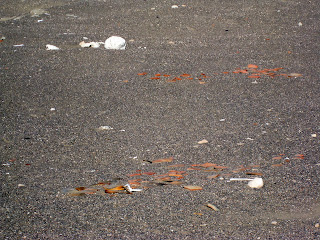
While we were here we took a short flight over the Nazca lines and got a bit of a information about them, as you do when you're a tourist. The lines and figures were created by the Nazcas just by picking up the rocks and putting them to the side. The rocks are a dark reddish-brown and the sand underneath is light grey, so removing the rocks leaves behind a light patch relative to the surrounding area. If you wanted to make a long straight line then simply using 3 sticks and lining them up will allow you to do that pretty easily. Perhaps a long bit of string between the sticks to assist with where to pick up the rocks. It turns out that many of these lines align with the sunrise at the winter solstice. Others point to water sources, while others may have just been ancient footpaths across the desert. The lines are between 1500 and 2000 years old. What they do reflect is the intelligence and advanced thinking of people that had a pretty hard life in one of the driest parts of the world.

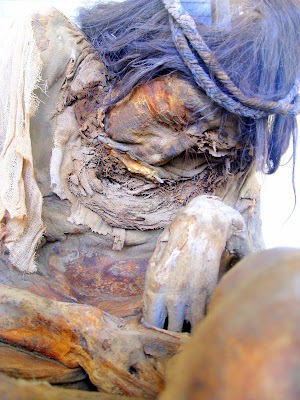
The other remarkable thing about this place are the mummies. It is possible here to drive to a place where you see human bones piled up on the dirt. While here we did a tour to Chauchilla, an ancient Nazca burial ground. However, in typical display of human red-necked greed, much of this area has been plundered by grave robbers and was only protected 15 years ago. People would dig up the graves, steal a bit of gold or ceramics, and sell them to museums and collectors around the world. Even when we were there we saw European tourists walking off the formed pathways, no doubt, crunching up human bones under their feet.

Some of the mummies are remarkably well preserved. You can see remains of skin, hair and fingernails. Our guide explained how the process worked.

Apparently they used to drain all the fluids out of the bodies, then sit them near the fire for a while to start the process off. After that they treated the skin with 'salts and peppers' to preserve the skin. After that the climate did the rest. It is very, very dry here, almost nothing grows.

The dryness and placing the bodies inside pits in the ground made a stable environment that allowed the preservation to work.


To view the slideshow please click here.

Tuesday, October 6, 2009

Catching up with the photos

We've spent a bit of time travelling lately in parts of Chile and Peru without Internet connections that we would brag about back home. Now we are in Lima, we have 1.5 Mb download and about .5 Mb upload speed, so I have spent some time catching up with the photos.

So if you have a bit of time on your hands check out these slideshows

The Atacama Desert (94 photos) click here

La Paz, Bolivia (56 photos) click here

Arequipa (51 photos) click here

Nazca (106 photos) click here

Happy viewing :-)

Sunday, October 4, 2009

The White City

We arrived in Arequipa after a very long and harrowing bus ride from La Paz. The journey was highlighted by a maniacal bus driver going way too fast. At one stage most of the passengers were airborne after we hit a bump in the road. Also, we had to sit right at the back of the bus where the toilets were. The toilets smelled like they had never been cleaned - ever - and every time someone opened the door you had to hold your breath for a while or risk dry reaching. A little girl on the bus befriended us and Kim gave her some chewing gum. From then on she just stood next to us the whole way just smiling and blowing bubbles. We probably encouraged her by blowing a few back.

Arequipa had a bit of a reputation as there was a documentary on TV earlier in the year where tourists had been kidnapped there in a taxi, and the people were tortured and made to give up their ATM cards and PINs. So we were a little nervous getting into taxis. However, the taxi driver was friendly and helpful and made sure he got us exactly to our hostel entrance. In fact all the taxis were good. The most we ever got charged was about 4 soles - $2 AU - so I tipped most of them a few extra soles. The trick is to use the official taxis, those with ID numbers, lights on top and stickers. The tourists that got kidnapped just accepted a ride from people with the word taxi scrawled on a beer carton on the dash apparently.

Arequipa is the second largest city in Peru, after Lima. There are about a million people living here. It is really spread out and looks huge, probably about Melbourne size, maybe a bit smaller. Arequipa is known as the 'white city' because of the Spanish buildings surrounding the central Plaza de Armas. Many of these building date back to the time the Spanish ruled here, maybe 400-500 years.

Recent earthquakes have done a bit of damage to the spires on the church but these have been rebuilt. Earthquakes are pretty common here - so too are volcanoes.

In the distance it is quite easy to see the huge volcano, El Misti, which means The Lord, in the indigenous peoples' language, Quechuan.

We did a fair bit of relaxing in Arequipa and didn't get out much, except to the restaurants. Although I did get my hair cut while I was here. The hair dresser only wanted to charge me 3 Soles ($1.50 AU) but she did an excellent job and didn't get much hair down my back, so I paid her 10 Soles and she was very happy.

We did a guided tour of the city before we left and visited most of the touristy places, including La Mansion Del Fundador, built by the Spanish Conquistadors, dating back to about 1540. Of interest in this picture is that the Roman soldiers that crucified Christ are depicted as Spanish Conquistadors, perhaps an early attempt at self-deprecating humour.

To view the slideshow please click here.

Sunday, September 27, 2009

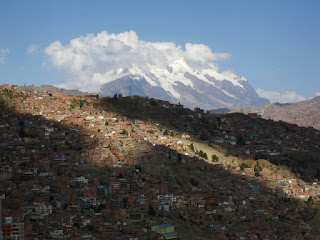
The highest capital city on Earth

La Paz, Bolivia is one of those places that conjures up images of extreme poverty, lawlessness, civil disobedience and other forms of plague and pestilence. While we did see a fair bit of poverty, we were met with probably the most friendly people of the journey so far.

La Paz is the highest capital city on Earth, at 3660 meters it is certainly up there. We got to about 4000 meters at least once on the way here and I was starting to feel out of breath from just from sitting on the bus. However, having had altitude sickness a number of times now, I am starting to work out how to handle it. My strategy is to not eat much and get plenty of rest on the first day. That is pretty easy as I don't mind the occasional siesta and have had almost no appetite since I have been here. Kim seems to have some superhuman resistance to it, but that's the way it goes apparently, some get it, some don't.


So the first day was a bit of a write-off for me but on the second day I felt fine even walking up hills. We went on a tour around the city and got to find out a bit about the history. It seems that Bolivia is suffering the death of 1000 cuts, once a much larger country it has lost a series of wars with its neighboring countries, and with that lost its access to the sea and much of its natural resources. People here are pretty poor, but there government still provides free education and free medical care for children and people over 65. Bolivia has the highest birth rate in South America with an average of five children per mother. A large percentage of its population are under 25. The retirement age is 65, but life expectancy for men is 60 and for women its 63.

Hardly anyone speaks English here, so Spanish is pretty much essential for most things. People find our accents a little hard to understand. For example, even though the word 'menu' is the same in both English and Spanish, you just can't say 'men you' like you do at home or in other parts of South America. Eventually one of the people I was speaking with got what I was saying and said 'men oo' (like oo in cool) and it was OK. Amazing how much a subtle pronunciation difference like that can make.

Anyway, given our interests in all things culinary, we went out for a curry somewhere in the city. That was OK, but nothing like curries that I am used to. More like an Indian-Chinese fusion dish, it was even served up with chopsticks. Anyway, we had 2 courses and 2 beers each and that cost $120 Bolivian, which is about $20 Australian. After that we went and bought a heap of silver stuff, some for Kim's upcoming 40th birthday, and a silver spoon for work. There are some big silver mines near here at Potosi.

After that we were walking down the street and we saw this European (Polish) couple struggling up the hill. The bloke appeared to be half carrying and half dragging his girlfriend and then he sat her down near a wall. We went over and offered some help. I ended up having to help carry the girl up to her room, further up the hill. Apparently, according to the bloke she just has funny turns and loses her sight and her balance. I must say I've never heard of that before. They didn't appear to be affected by alcohol or drugs. She was crying quietly and I was struggling a bit myself with a residual leg injury and still some high altitude breathlessness. Anyway, my good deed for the day I suppose. The bloke was really grateful that I helped them.

Then the next day we caught a bus out of Bolivia on our way to Peru. There are hundreds of buses in Bolivia, and maybe 10-20 different bus companies operating here. When we got on the bus, someone had taken our seats, that in itself isn't that unusual. I thought I recognised the people that had our seats, it turns out it was the same Polish couple that we had helped the night before. I asked them if we had helped them last night to confirm what I thought. It was bizarre enough them being on the same bus, without adding to the coincidence of them somehow being allocated the same seats as us.


Here is an interactive panorama from the top of La Paz. The image will rotate by itself, but if you click on it and hold the mouse button down you can control where it goes. Also notice the + and - buttons on the bottom left hand side if you want to zoom in or out. Try tilting the image up then zooming in and around the skyline. Good luck!!

To view the slideshow please click here.